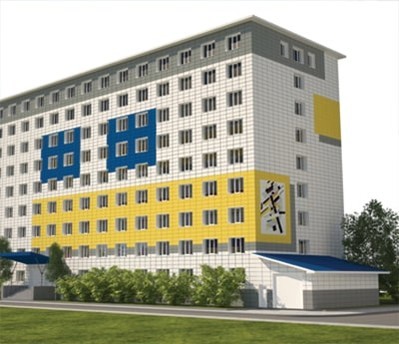
1.1.1The market for modern temporary housing has fundamentally changed over the past decade. Today's dormitories bear no resemblance to the utilitarian Soviet-era dormitories, where the main priority was maximizing occupancy with minimal square meters per person. Modern projects are comfortable residential complexes with well-planned infrastructure, designed to support a full-fledged life, work, and leisure.
The relevance of constructing modern dormitories continues to grow due to several factors: migration trends, the development of educational mobility, and the need for companies to attract qualified specialists from other regions. For universities, modern student campuses have become a significant competitive advantage in attracting applicants, while for companies, they serve as a tool for retaining valuable personnel.
Classification and Typology of Modern Dormitories
Modern dormitories are classified according to several parameters: length of stay, intended purpose, and layout solutions. Accommodation for temporary stays (up to 6 months) typically features basic amenities, whereas long-term living spaces are designed as full-fledged residential units with developed infrastructure.
Based on layout, there are four main types:
-
Cluster Type — The most popular model, where the building is divided into autonomous blocks, each including 3-4 bedrooms, a bathroom, and a mini-kitchen. Each block is a self-contained space, ensuring a balance between privacy and social interaction.
- Apartment Type — Involves individual rooms with private facilities, while kitchens and common areas are shared on each floor. This model is optimal for graduate students and young professionals.
- Corridor System — An economical option where living rooms are located on both sides of a shared corridor, with bathrooms and kitchens on each floor. Modern projects of this type feature larger rooms and better-equipped common areas.
- Hotel Type — The premium segment, where each room has a private bathroom and, in some cases, a compact kitchenette. This format is in demand for hosting international students and faculty.
Key Aspects of Designing Modern Student and Worker Residences
When creating next-generation dormitory projects, a range of factors beyond mere housing provision are considered. Architectural and planning solutions aim to create a multifunctional environment, including:
- Study areas and coworking zones with modern equipment.
- Sports complexes with gyms and spaces for group activities.
- Areas for social activities and informal interaction.
- Food service establishments: from cafeterias to coffee shops.
- Laundry and utility rooms with modern appliances.
- Medical offices and psychological support services.
Particular attention is paid to creating a barrier-free environment for people with disabilities, including not only ramps and elevators but also specialized sanitary equipment, tactile navigation, and adapted furniture.
Technological Innovations in Dormitory Construction
Modern dormitory projects actively utilize advanced construction technologies and materials. Energy-efficient solutions include heat recovery systems, solar panels, smart lighting, and water supply systems, significantly reducing operational costs.
Building Information Modeling (BIM) has become the standard for such projects. Digital twins of buildings enable:
- Coordinating all project participants in a unified information space.
- Identifying and resolving clashes during the design phase.
- Optimizing material usage and construction timelines.
- Creating precise operational documentation.
Trends and Development Prospects
The student and worker housing market continue to evolve towards integrated solutions. There is growing demand for apartments with private bathrooms, an increase in space per resident to 12-15 m², and the development of the smart campus concept with integrated security and management systems.
A promising direction is the creation of hybrid spaces that combine living, working, and leisure functions. Such projects include coworking spaces, meeting rooms, creative studios, and gyms, which are particularly relevant in the era of remote work and learning.
Professional Solutions from MARASHSTROY
MARASHSTROY LLC specializes in creating modern dormitories and student campuses that meet current standards of comfort and functionality. The company's portfolio includes completed projects for leading educational institutions and corporate clients, such as:
- Student campuses with comprehensive infrastructure.
- Corporate dormitories for company employees.
- Multifunctional temporary residential complexes.
Ready to create a modern, comfortable, and functional dormitory that will become a competitive advantage for your educational institution or company? Contact MARASHSTROY LLC for a consultation and to develop an individual project. The company's specialists will offer optimal solutions that consider the specifics of your site, budget, and functional requirements. From design to turnkey project delivery—we ensure a full project lifecycle with quality guarantees and adherence to deadlines.