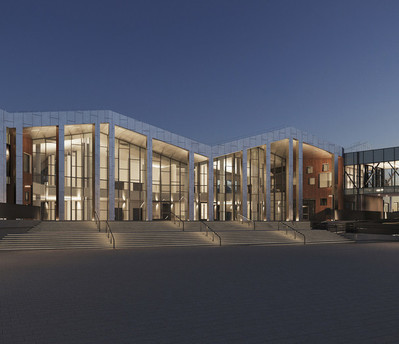
A modern university is no longer just a collection of academic buildings; it is a multifunctional, technological, and complex organism designed to create an environment for learning, research, creativity, and daily life. The architecture of these complexes must not only meet functional requirements but also inspire, foster the generation of ideas, and provide a comfortable space for students, faculty, and staff.
The facilities of a modern university encompass far more than traditional lecture halls and libraries. Today, they include:
- Spaces for collaborative work (coworking) and individual study.
- Digital media libraries and laboratories with cutting-edge equipment (from 3D printers to high-performance computing clusters).
- Comfortable relaxation and informal social zones.
- Food service establishments: from cafeterias to coffee shops.
- Modern sports complexes, including swimming pools and fitness halls.
- Smart classrooms with video conferencing systems and interactive panels.
Specifics of University Design and Construction: From Concept to Completion
The primary objective in creating a modern university campus is to design not just buildings, but an integrated educational ecosystem. This is a space where all elements are interconnected and work towards a single goal: unlocking the potential of every student.
Depending on its scale and specialization, such a campus may comprise
- Main Academic Cluster – the main administration building, a central library with a digital archive, large amphitheater-style lecture halls.
- Specialized Faculty and Institute Buildings, designed with their specific needs in mind (laboratory modules for chemists, soundproof studios for musicians, workshops for designers).
- Research Centers, equipped with state-of-the-art technology.
- Student Campus with apartment-style dormitories, townhouses for postgraduate students and visiting professors.
- Social and Amenity Infrastructure – a medical center, post office, banks, shops.
- Leisure and Sports Facilities – stadiums, gyms, art galleries, and student clubs.
Key Nuances That Cannot Be Overlooked in Design:
- Flexibility and Transformability. Modern education evolves rapidly. The design must allow for easy reconfiguration of interior spaces for new tasks. For example, movable partitions in classrooms enable quick zoning for different class formats.
- Creating Collaborative Environments. Architecture should encourage informal communication and interdisciplinary interaction. Wide corridors with seating niches, atriums with amphitheater-style staircases, open kitchenettes on floors—all these are places where chance encounters and new ideas are born.
- Technological Integration. A robust IT infrastructure is incorporated from the design stage: high-speed Wi-Fi 6, a smart campus system for managing energy consumption and security, and microclimate control sensors.
- Eco-Friendliness and Sustainable Development. The trend is towards creating green campuses. This involves using solar panels, heat recovery systems, green roofs, rainwater harvesting for irrigation, and employing eco-friendly materials. Such solutions not only protect the environment but also serve as practical teaching tools for students.
- Inclusivity. The environment must be comfortable and accessible for everyone without exception. This means not only ramps and elevators but also tactile navigation for the visually impaired, adapted restrooms, and specialized equipment in classrooms.
- Space for Future Growth. A 25-30% land reserve is not a luxury but a necessity. The university develops, and in 5-10 years, space may be needed for a new school of engineering building or a startup incubator.
The Design Process: How a Future University Takes Shape
Design is the most critical phase. It is not just about placing buildings on a site, but about meticulously planning logistics, connections, and the life scenarios within the university. Specialists consider:
- Learning Formats. The growing popularity of distance and hybrid programs requires specific solutions for high-quality online broadcast studios and IT infrastructure.
- Demographics. Calculating the load on all facilities based not only on the total number of students but also on their schedules, helping to avoid cafeteria queues and overcrowding in lobbies.
- Integration into the Urban Fabric. A modern university is not an isolated territory but part of the city. Projects often include creating publicly accessible spaces: parks, libraries, cafes that can also be used by citizens. This blurs boundaries and strengthens the university's ties with the community.
- Rational Use of Underground Space. It is efficient to place parking, technical rooms, storage, and logistics centers underground, freeing the surface for pedestrians and green zones.
Experience and Technology in the Service of Quality
The company MARASHSTROY possesses substantial experience in creating educational clusters. We understand that we are building not just structures, but an environment that will shape future scientists, engineers, and creators for decades to come.
Our primary tool is BIM technology. We create not just drawings, but a 3D model containing all information: from the rebar grade in the foundation to the light bulb replacement schedule in the classrooms. This allows us to:
- Experience all operational stages of the building in virtual reality before construction begins and identify potential weaknesses.
- Avoid costly errors and clashes, for instance, when a ventilation duct conflicts with a light fixture location.
- Calculate budgets and timelines more accurately.
- Hand over not just a folder of documents to the client, but a digital twin of the building, simplifying its future maintenance and management.
Our team of highly qualified specialists—from architects and engineers to site managers and cost estimators—works as a single, well-coordinated mechanism. We offer not standard solutions, but an individual approach that considers the uniqueness of each educational institution—be it a technical university, a humanities institute, or an agricultural academy. Our goal is to create not just a functional, but an inspiring space where people are motivated to learn, create, and change the world for the better.