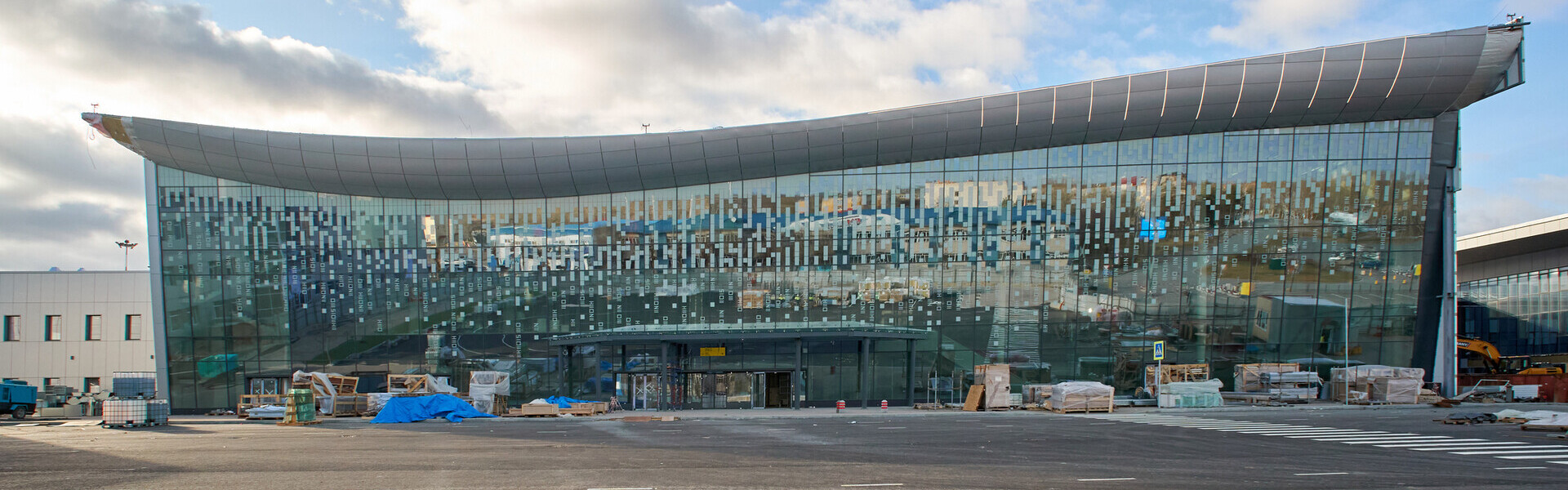
In the modern global economy, airports have ceased to be mere points on a map for aircraft takeoff and landing. Today, they are grand multimodal hubs that act as catalysts for the economic development of entire regions. They have evolved into complex ecosystems with developed infrastructure, integrated commercial, business, and entertainment zones, hotels, and logistics centers. MARASHSTROY approaches the creation of such facilities as a comprehensive task, where the future of civil aviation is born at the intersection of innovation, safety, and architectural vision.
The aesthetic component of modern airports plays a role no less important than their functionality. Unique architectural solutions transform terminals into landmarks for cities and countries, becoming tourist attractions that form the first and strongest impression for arriving visitors. However, behind the external lightness and elegance of glass and metal lies colossal engineering work. An airport is a high-risk facility, and its design and construction adhere to the most stringent international and national standards, laws, and regulations guaranteeing absolute safety for passengers and staff.
Classification and Types of Layout Solutions
The scale of an airport passenger complex is directly dependent on the forecasted passenger traffic, reflected in the commonly accepted classification that divides airports into five classes. The largest international and federal hubs, handling from two million passengers per year and above (Classes 1-3), require the most complex and large-scale solutions. Class 4 and 5 airports typically serve regional and local airlines.
Depending on the scale and purpose, various layout forms are applied:
- Centralized (Single-Module): Compact terminals where all operations are concentrated in one building. An efficient solution for small airports with moderate traffic, serving primarily general aviation.
- Block (Decentralized): The terminal building is functionally zoned into blocks: departure area, arrival area, administrative buildings, technical premises. This structure allows for effective management of passenger and transport flows.
- Pavilion (Distributed/Branched): This form is characteristic of the largest international airports. The complex consists of several spacious pavilions (terminals), connected by galleries or underground tunnels. This solution allows for maximum separation of passenger flows, ensures high throughput, and accommodates extensive commercial and service infrastructure. Due to their gigantic sizes, such complexes are always located outside city limits.
Modern Technologies in Design and Construction
The foundation for creating next-generation airports lies in advanced materials—high-strength reinforced concrete structures, lightweight and durable metal alloys, energy-efficient glass. However, the real revolution is happening in the field of design. MARASHSTROY LLC actively utilizes BIM technologies (Building Information Modeling), which enable the creation of a complete digital model of the future airport.
Information modeling is not simple 3D visualization, but a unified intelligent model containing all architectural, structural, engineering, and economic data about the facility. This approach ensures:
- Visualization and Analysis. Assessment of the building's aesthetics, ergonomics, and functionality even before construction begins.
- Clash Detection. Automatic identification and resolution of conflicts and errors in utility and structural designs.
- Precise Planning. Calculation of exact material quantities and work costs (4D and 5D BIM), optimization of the construction schedule.
- Realization of Complex Forms. Bringing the boldest architectural ideas to life, which would be impossible to calculate and implement using traditional methods.
The digital twin, created during the design phase, continues to serve throughout the entire building lifecycle, simplifying its operation, modernization, and repair.
Key Aspects of an Airport Complex Project
Work on an airport project encompasses all aspects of its future operation:
- Master Plan and Transport Infrastructure. This section defines the location of all buildings on the territory, including terminals, hangars, administrative buildings, and cargo areas. Primary focus is on developing efficient access roads, organizing parking, public transport stops, and integration with railway links. Landscape design and greening schemes are also elaborated.
- Architectural Solutions. This shapes the visual identity of the future airport. It includes not only visualizations of facades and interiors but also detailed descriptions of functional zoning, passenger flow routes, and the applied finishing materials and their characteristics.
- Structural Solutions. The most critical part of the project, involving highly complex load calculations for all load-bearing elements of the building—from the foundation to unique roof structures. It contains detailed drawings and diagrams of all structural components, guaranteeing the strength and durability of the structure.
- Engineering Systems. A modern airport is a highly complex organism, whose vital functions are supported by dozens of engineering systems: robust power supply, water supply and drainage, heating, ventilation, and climate control (HVAC), fire suppression, communication and security systems, as well as specialized systems like baggage handling and telescopic bridges.
Passenger Comfort and Commercial Potential
The modern design approach prioritizes passenger convenience. Spacious, intuitively understandable waiting areas with comfortable furniture, providing at least 1.3-1.5 m² per person, are just the foundation. Crucial roles are played by clear navigation, accessibility for people with reduced mobility, availability of high-speed Wi-Fi, and family zones. Retail outlets, cafes, restaurants, and service centers are harmoniously integrated within these areas, transforming waiting time into a pleasant and useful experience.
MARASHSTROY possesses deep expertise in the design and construction of airport complexes of any complexity class, ensuring consistently high quality at all stages of work. Our experience in implementing unique and technically complex projects is confirmed by a portfolio that includes the construction of major airports in Khabarovsk, Rostov-on-Don, Volgograd, and Chelyabinsk. These facilities have become not only modern transport hubs but also striking architectural landmarks in their regions, demonstrating our impeccable craftsmanship and ability to bring the most ambitious projects to life.